The digital catastrophe
Why has the service of a state institution become significantly less user-friendly with 27% more staff? One would have expected a halving of the staff.
In 1976 I got my first programmable calculator, in 1979 my first computer, an apple ][. From 1982 to 1985, I was a system programmer at SKIDATA, then self-employed in the software sector. But today I have to write about the digital catastrophe. Why?
Because many things have become grotesquely complicated instead of simple, let's take the registration of an employee. In 1988, I registered my wife as a self-employed employee. So I drove to the regional health insurance fund and looked for a parking space. I can't remember if it was a paid short-term parking zone back then, so I asked an employee where I had to go. There was an official there who probably dealt with twenty such cases a day, who then filled out the form with me. It was easy, any employer could do it.
On February 2024, I registered my daughter Maria as a part-time employee. My battle through the digital jungle. The company account at the UPS company service portal is not enough. So I had to register again somewhere else. After all, I think most entrepreneurs hire a company that specializes in this kind of thing.
Then every few months I received a reminder for small amounts of less than €10. So if my e-mail address is known for sending reminders, why don't they just send an invoice?
In 1988, you were still personally assisted by an employee at the GKK when registering. Today this is only possible online in a very complicated way. How many employees did the GKK have in 1988 and today?
Comparison of the number of employees at the GKK (Steiermärkische Gebietskrankenkasse, today ÖGK branch office Styria)
Steiermärkische Gebietskrankenkasse (GKK) existed as an independent institution until the merger with Österreichische Gesundheitskasse (ÖGK) in 2020. The personnel figures therefore refer to the historical status in 1988 and the current number of positions (full-time equivalents) of the ÖGK branch in Styria for 2024.
| Year
| Number of employees
| Source
| | 1988
| 1.171
| Austrian Parliament (Document 228/A, 1995)
| | 2024
| 1.404
| Austrian Health Insurance Fund (VP positions)
|
Between 1988 and 1994, the number at GKK Steiermark rose slightly to 1,243 ( 72 employees), which was part of a general trend among regional health insurance funds. Today, the number of staff at the Styrian branch of ÖGK is slightly higher, which could be due to digitalization and increasing numbers of insured persons - in line with your observation about the shift from face-to-face to online care.
Because I didn't mention Salzburg, Grok used Styria as an example. But with all the digitalization, I would have expected at least a halving of the workforce, but certainly not 20% more employees. They have managed to make it much more complicated for a simple employer by employing 20% more staff.
Question for Grok:
Is it possible to estimate how many external employees were deployed in 1988 and today?
I think the digitization was carried out by external service providers.
Here's a PDF with the entire discussion. The estimate is 0 to 20 in 1988 and 50 to 150 in 2025. In each case, adding the mean of the estimates: 1171 10 = 1181. But 1404 100 = 1504. Wow, including the external staff we are up 27%.
Cost savings and service improvements through digitalization really do seem to be a resounding success.
|
MIA - Mission Innovation Austria
|
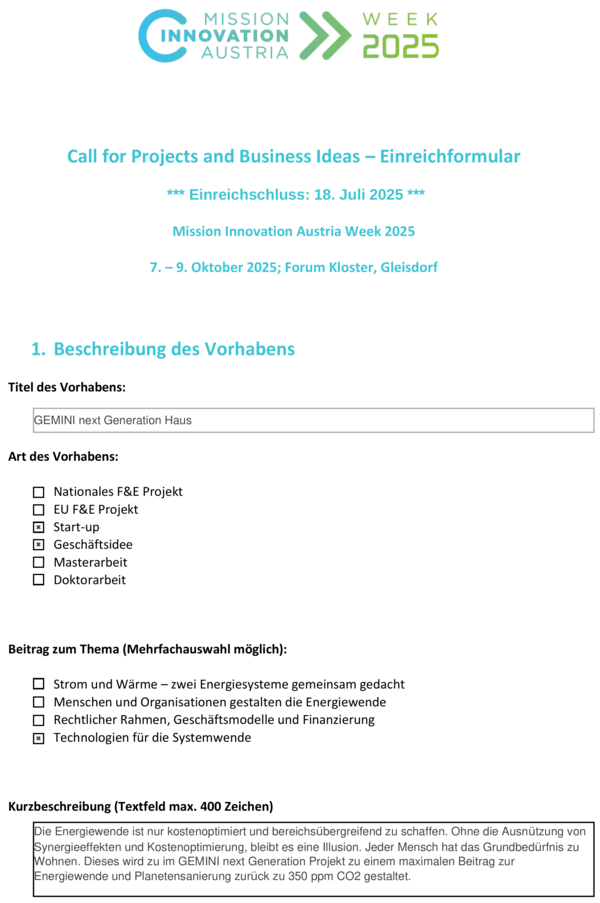 We will be presenting a poster at the central annual meeting for the energy transition in and from the regions October 7-9, 2025 | forumKloster, Gleisdorf.
|
The net-zero emissions mentality
|
Net zero emissions means reducing greenhouse gas emissions to a level that nature can supposedly absorb for a long time. For the rich, this means Maintain poverty, cause poverty, so that enough emission rights remain for the rich. See the architect and her opinion that Africans don't need roads.
|
The planetary restoration mentality
|
Planetary cleanup back to 350 ppm CO2 means about 47,000 TWh of electricity to filter 1 ppm CO2 from the atmosphere and recycle it into carbon and oxygen. Who can afford that? Only a rich human race, 10 billion people in prosperity can do it. One million km² of energy-optimized settlement areas alone should contribute 150,000 TWh for the necessary electricity for world-wide prosperity and planetary restoration.
|
GEMINI next Generation AG will prove the contrary
|
It's not about whether the shares will be worth 100 times or 1000 times more in 20 years' time or whether they will only be worth a few cents. It's about the future of us all. Will there be a big showdown between eco-fascism and yesterday's fossils, or will it be possible to overcome the deep divisions in society and inspire supporters of both sides to work towards a great new goal?
Global prosperity and planetary restoration instead of saving, restricting, renouncing and climate catastrophe or peak oil and a little more climate catastrophe. Both sides must be convinced that they have no solution that is even remotely viable.
On the one hand, it must be shown that net-zero emissions are a completely inadequate target and that the goal must instead be a planetary clean-up back to 350 ppm CO2. The other side must be shown that solar power enables a higher standard of living than fossil energy.
It's about survival! The social situation in 2025 compared to 2005, extrapolated to 2045, makes for a horror world! If we are successful and your shares are worth 100 times more, this is just an addition to all the other achievements.
One new shareholder said "Me with my very modest investment", but €400 times €1,000 is also €400,000 for all investments up to the creation of the prototype.
There is a reward program for recommending the share to others. Two of the new shareholders have become shareholders through this reward program.
Here are the details.
|
GEMINI shares: time to buy - milestones
|
The situation has changed fundamentally since this company visited Slovakia. Necessary investment volume reduced by around 90%. Time to marketable product shortened by around one year. The 90% reduction in investment volume also means that each shareholder has significantly more shares.
The share price is now lifted towards our targets at each milestone. These milestones can happen in all areas: Financial, new shareholders, new opportunities to attract new shareholders. Contracts to build the prototype, more houses and settlements. Cooperations for realization. Purchase, arrival and testing of important technical components. |