Market economy vs. subsidized economy
Donkeys live for 27 to 40 years. The first major subsidies for photovoltaic systems were provided in 1990, so it's quite clear that the donkey for the PV subsidy can die at any time.
|
76% of new registrations of electric cars in Nepal
|
Last week I learned that Nepal has 76% new registrations of electric cars.
How so? Norway said that our citizens should drive with cheap electricity from hydropower, then there will be more oil left over for export. Nepal thinks that our citizens should drive with cheap hydroelectricity so that gasoline and diesel imports no longer spoil our extremely negative trade balance.
But what does this look like in remote villages that are not connected to the general power grid? Local power grids that are good for lighting and washing machines, but where you can't connect a 1 MW fast charger for trucks. That's why I investigated this with my simulation software and the hourly yield estimates of the EU photovoltaic calculator from 2005 to 2023.
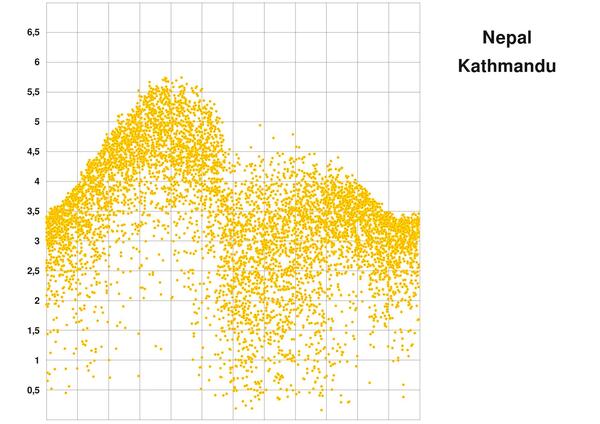
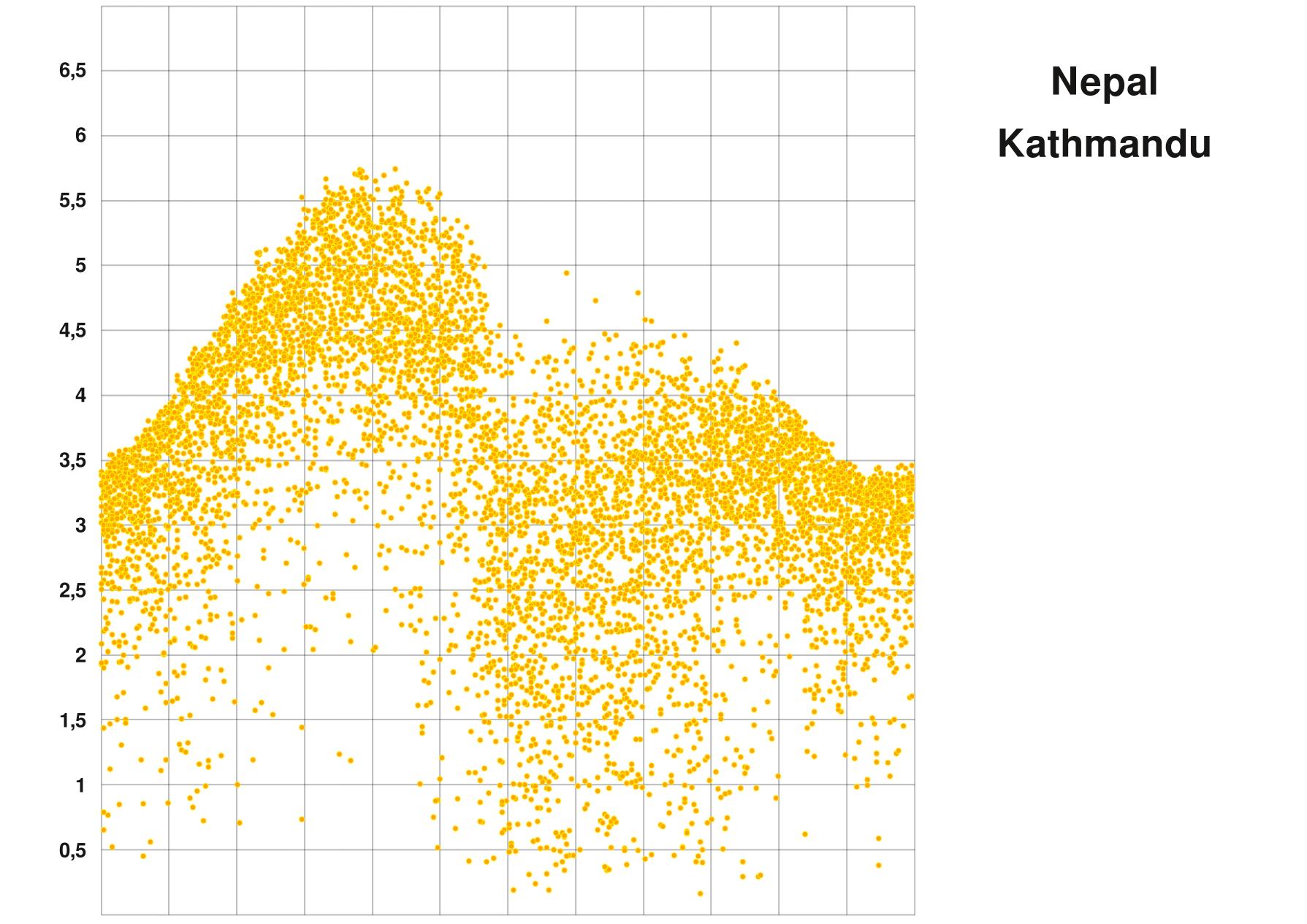
Diagram of solar yield in Kathmandu. From left to right the 365 days of a year, from bottom to top the yield. Line 1 means 1 kWh yield for 1 kW peak photovoltaics. The rainy season from June to September is clearly visible
There are 4 reasons to store electricity:
- Short-term high power requirement - fast charging
- Earth rotation - day/night
- Weather fluctuations - sunny/cloudy
- Inclination of the earth's axis - summer/winter
While the battery has a clear advantage for the first two reasons, only methods that convert electricity into a chemical energy source can be considered for the last two reasons. In my simulation software, different configurations with different loads are tested to find the most favorable variants: 3 MWh sodium batteries per MW of photovoltaics and 100 kW power to methanol.
Typically, Power to Methanol had 4,000 to 5,000 full-load hours, depending on the utilization of the fast chargers. During the night, power to methanol is supplied with electricity from the batteries. Surely this should be valuable information for all the institutions involved with power to methanol?
A few phone calls later, I had to recognize the difference between a market economy and a subsidy economy when I analyzed the reason for the total lack of interest: the top players in the market economy are looking for gaps in the market, future trends, the first profitable areas of application for new technology. The top players in the market economy are like Pele, who sees the goalkeeper too far ahead and scores from the halfway line, like Maradona, who played around the opposing team at kick-off as if there were senior citizens with walking frames on the pitch. In the market economy, you would have to compare Pele and Maradona with Elon Musk and Wang Chuanfu (founder of BYD). The opponent is the fossil fuel industry and they are looking for gaps where they can strike successfully. Elon Musk found this gap in 2012 with the Tesla S luxury car, Wang Chuanfu in 2010 with the BYD e6 electric car and K9 electric bus. So it's not "Hurray, we're building an electric car", but "Which electric car can make a profit over the fossil fuel competition for the first time?".
The subsidy economy looks completely different: The state wants to promote a project, "Hooray, we've found a ducat donkey!". For example, a state dreams of all ships and airplanes being supplied by power-to-methanol plants.
I was told about hundreds of square kilometers of plants in the desert where methanol is to be produced with solar power to power ships and airplanes. Studies on the first commercially viable power-to-methanol plants? No interest at all, the donkey wants gigantic visions far in the future and no first profitable applications here and now.
What's the difference? With these hundreds of square kilometers of vision, the entire cost must be allocated to the methanol produced and then there are the transport costs to the consumer.
However, these off-grid fast-charging settlements are completely different: here, only the price of the power-to-methanol system is calculated compared to the purchase of gasoline, diesel or methanol in order to be able to maintain operation with a generator on days with low yields. The photovoltaics and the battery are there either way. With power to methanol, only otherwise unusable surplus electricity is utilized. At € 100,000 for 100 kW of power to methanol with 50% efficiency, there would be great rejoicing: 5,000 full-load hours per year × 20 years × 100 kW × 50% efficiency divided over a purchase price of € 100,000 is only 2 cents per kWh of chemical energy source.
|
The market remains, subsidies can disappear
|
Making yourself dependent on a ducati donkey with lofty to unrealistic visions is highly risky. The government can change and cancel this project: a hard crash landing. Subsidies are sometimes necessary, but the most important question is always: in how many years can the product survive on the free market? When feed-in tariffs were radically cut in Germany in 2013, the photovoltaic industry was only a few years away from broad profitability on the free market, but only in conjunction with batteries to refine flutter power into peak power. As early as 2012, there were clear solar valleys on the spot market with prices below 1 cent/kWh at midday. When the spot market price drops significantly at midday, I first called it a solar dip, then a solar valley and later even a solar gorge: There are the high mountains with 20 cents/kWh in the morning and evening and in between this steeply sloping deep gorge with -20 cents/kWh.
In 2022, the Scholz government significantly increased the feed-in tariffs for PV electricity in Germany. We are seeing the catastrophe today: more and more days with negative spot market prices. In Germany, the difference between the spot market price and the EEG feed-in tariff is paid by the taxpayer via the EEG surcharge. What will happen to the German solar trade if there is soon to be no more feed-in tariffs?
This industry exists in the comfort of state subsidies: If the customer gets so many cents in feed-in tariffs, then we can sell the system for that price.
I spoke to a few solar companies, a few of which became shareholders, the majority said: "What's this lunatic talking about the free market? We don't need it, we have the EEG", some hated me like the plague.
Any thought of the limited life expectancy of a ducat donkey has been suppressed: donkeys live for 27 to 40 years. The first major subsidies for photovoltaic systems were granted in 1990, so it is quite clear that the donkey's life could be over at any time. Despite all the warnings: The solar industry is now facing another catastrophe after 2013.
|
GEMINI next generation house is designed for the open market
|
The goal was already clear in 2019: to make a profit on the spot market by converting solar power into peak electricity via batteries. Energy income instead of energy expenditure as a revolution in home financing: if the difference between energy expenditure in a conventional house and energy income from the spot market in a GEMINI next generation house is €600 per month, this can be used to pay off a €150,000 home loan.
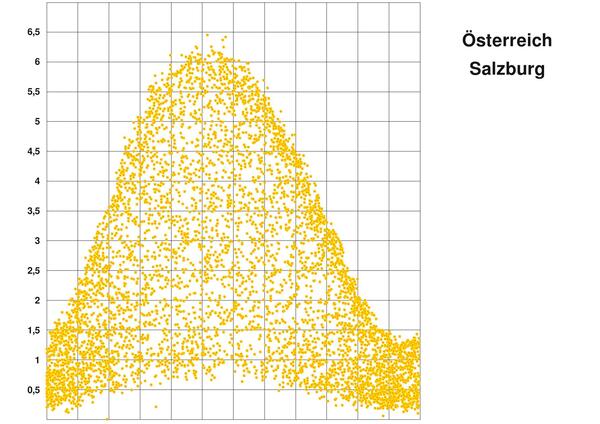
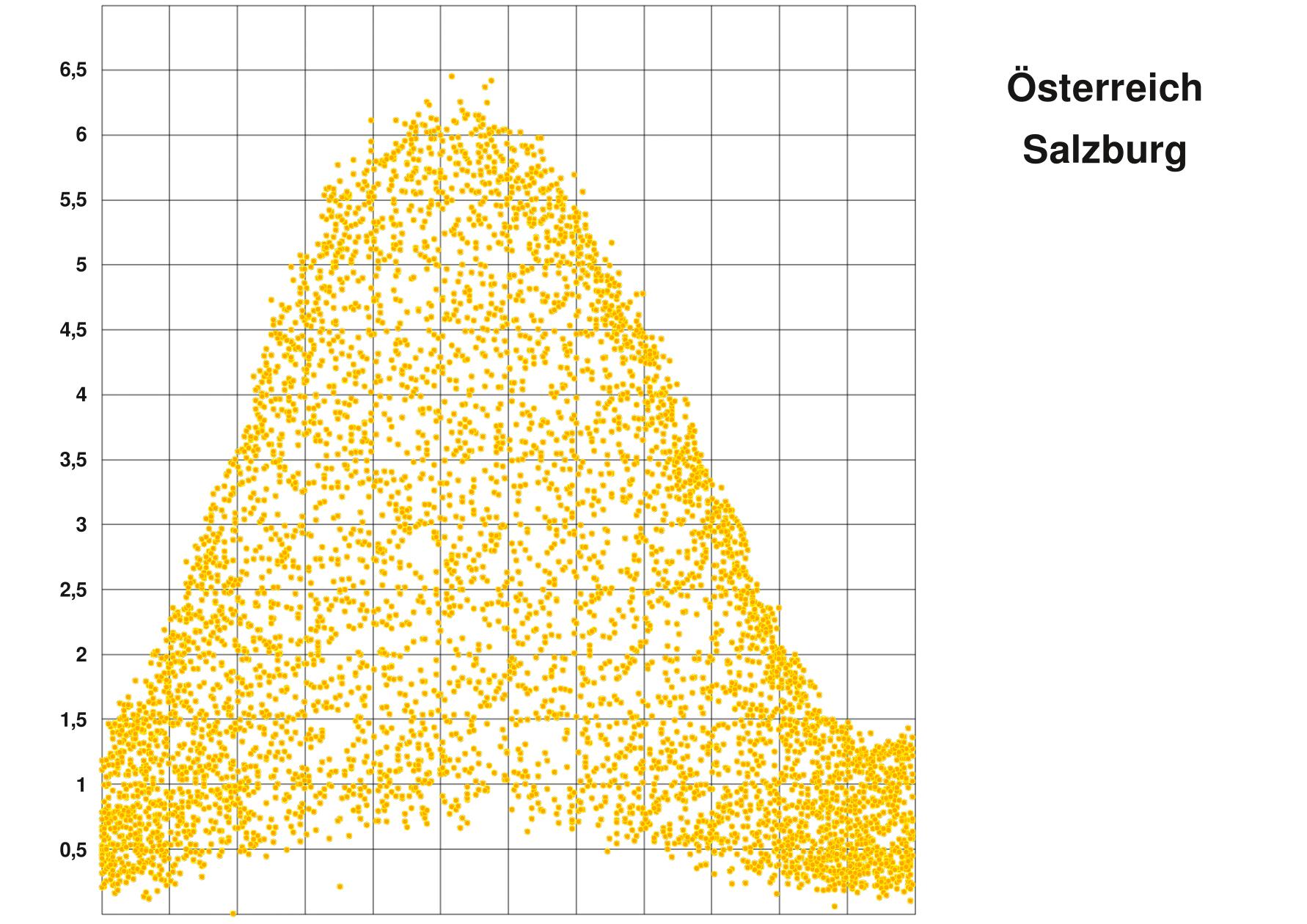
Salzburg's sleet vs. the rainy season in Kathmandu: Salzburg is a very sunny city
|
MIA - Mission Innovation Austria
|
 We will be presenting a poster at the central annual meeting for the energy transition in and from the regions October 7-9, 2025 | forumKloster, Gleisdorf.
|
Property search for projects
|
I have on ImmobilienScout24.at
searched for properties of 350 m² or more. There are 25 entries on each results page. I looked through the first 19 pages and found 55 suitable plots. The selection criteria were suitable for residential construction and under €200 per square meter. Some were plots of up to 6,500 m², which are already suitable for 10 houses. Only one was in the federal state of Salzburg, none in Tyrol or Vorarlberg. So almost only Upper Austria, Lower Austria, Burgenland, Styria and Carinthia.
The apartments range in size from 56 m², suitable for a retired couple, to 118 m² for a large family. With 2 to 4 rooms there are 56 m² to 97 m². With 4 to 6 rooms there are 89 m² to 118 m².
The houses themselves have between 33 kW and 55 kW of photovoltaics.
If the prototype can be financed quickly now, it will be possible to compensate for the enormous delay caused by the monkey business with the rare lizards: Prototype at the end of 2025, series production from fall 2026.
A simple calculation example: What is a share worth if a company value of 300 million is divided into 150,000 shares?
|
The net-zero emissions mentality
|
Net zero emissions means reducing greenhouse gas emissions to a level that nature can supposedly absorb for a long time. For the rich, this means Maintain poverty, cause poverty, so that enough emission rights remain for the rich. See the architect and her opinion that Africans don't need roads.
|
The planetary restoration mentality
|
Planetary cleanup back to 350 ppm CO2 means about 47,000 TWh of electricity to filter 1 ppm CO2 from the atmosphere and recycle it into carbon and oxygen. Who can afford that? Only a rich human race, 10 billion people in prosperity can do it. One million km² of energy-optimized settlement areas alone should contribute 150,000 TWh for the necessary electricity for world-wide prosperity and planetary restoration.
|
GEMINI next Generation AG will prove the contrary
|
It's not about whether the shares will be worth 100 times or 1000 times more in 20 years' time or whether they will only be worth a few cents. It's about the future of us all. Will there be a big showdown between eco-fascism and yesterday's fossils, or will it be possible to overcome the deep divisions in society and inspire supporters of both sides to work towards a great new goal?
Global prosperity and planetary restoration instead of saving, restricting, renouncing and climate catastrophe or peak oil and a little more climate catastrophe. Both sides must be convinced that they have no solution that is even remotely viable.
On the one hand, it must be shown that net-zero emissions are a completely inadequate target and that the goal must instead be a planetary clean-up back to 350 ppm CO2. The other side must be shown that solar power enables a higher standard of living than fossil energy.
It's about survival! The social situation in 2025 compared to 2005, extrapolated to 2045, makes for a horror world! If we are successful and your shares are worth 100 times more, this is just an addition to all the other achievements.
One new shareholder said "Me with my very modest investment", but €400 times €1,000 is also €400,000 for all investments up to the creation of the prototype.
There is a reward program for recommending the share to others. Two of the new shareholders have become shareholders through this reward program.
Here are the details.
|
GEMINI shares: time to buy - milestones
|
The situation has changed fundamentally since this company visited Slovakia. Necessary investment volume reduced by around 90%. Time to marketable product shortened by around one year. The 90% reduction in investment volume also means that each shareholder has significantly more shares.
The share price is now lifted towards our targets at each milestone. These milestones can happen in all areas: Financial, new shareholders, new opportunities to attract new shareholders. Contracts to build the prototype, more houses and settlements. Cooperations for realization. Purchase, arrival and testing of important technical components. |