Hungary plans 300 GWh battery production by 2030
Let's look at Hungary's economic policy from the point of view of “A Hungarian is someone who goes in behind you into a revolving door and comes out in front of you."
|
There are some very strange opinions
|
If you mention battery production in China to the carriers of these extremely strange opinions, the response is "green madness", "communist regime", "planned economy", "they are building so many coal-fired power plants" and the like.
I think Viktor Orbán is beyond any doubt, he could be a green nutcase. Let's look at Hungary's economic policy from the point of view of "a Hungarian is someone who goes in behind you in a revolving door and comes out in front of you".
|
Hungary plans 300 GWh battery production by 2030
|

What is an annual production of 300 GWh of batteries? For 100% new registrations of electric cars in Germany, 3 million new cars times 60 kWh would be necessary. This is only 180 GWh of batteries per year. Then let's add GEMINI next Generation AG's wildest visions of the future: the entire residential construction in Germany only with energy-optimized residential areas: 600,000 new homes per year with an average of 80 kW peak photovoltaics and 200 kWh battery. 600,000 times 200 kWh are 120 GWh batteries. Now we have a vision of the future with 300 GWh of batteries required annually for Germany's 83 million inhabitants. Only this production capacity is planned for the 9.5 million inhabitants of Hungary.
|
How can you sell 300 GWh of batteries per year?
|
As is so common with emerging new industries: with price reductions. The first emerging new industry was the oil industry from 1859 to 1893, where the price fell steadily. Henry Ford radically reduced the price of new cars from an inflation-corrected US$ 80,000 to US$ 5,000 for his Ford T. Televisions, computers and photovoltaics are further examples of price reductions in new emerging industries.
|
Tesla foundation was a bet on falling battery prices
|
The founding of Tesla in 2003 was a bet on falling battery prices. They started where price was the least important factor: with the Tesla Roadster. The first Tesla S in 2012 had an 85 kWh battery. In 2003, a kWh lithium battery was around €2000. At the battery prices of 2003, a €170,000 battery could not even have been accommodated in the luxury class. Like many automotive developments, this innovation started at the top end of the price scale.
- 100 kWh at €300 is possible in the upper class
- 80 kWh at €200 is possible in the upper mid-range
- 60 kWh for €100 is possible in the lower mid-range
- 50 kWh at €60 is enough to sweep EU used cars off the African market with new electric cars
|
The development of photovoltaics
|
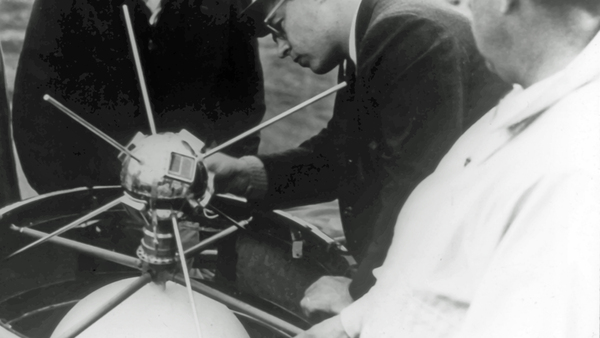 Scientists mount tiny photovoltaic cells on the 1st US satellite Vanguard in 1958
It started with tiny niche markets: in 1954, photovoltaics were still uneconomically expensive even for telephone repeater stations without a power connection. In 1958, the first US satellite Vanguard had tiny photovoltaic cells.
In 1990, global production finally reached 50 MW, at a price of €7 per watt peak. This increased to 600 GW in 2024. 12,000 times more production in 34 years is 32% annual growth. The price reduction to 12 cents per watt peak is -11.2% inflation.
12,000 times more production is 13.55 doublings. The price has fallen by 26% per doubling of the global market.
Rechargeable batteries follow a very similar path.
A profitability transition is when there are two competing products and one product becomes cheaper than the other. Around 1910, the profitability transition was from horse to car in transportation. Before that, a car was only something for the rich, today a horse is only something for the rich as a sport and hobby device.
Why did the first GEMINI house turn to face the sun and the new one has an east-west roof? There was a transition in profitability in 2010: photovoltaics became so much cheaper that it was no longer worthwhile using a rotating mechanism to maximize the electricity yield per kW peak.
|
GEMINI next generation is a bet on falling battery prices
|
Where are the batteries in the power supply? West Berlin was an island grid until reunification. In 1986, West Berlin had 14.4 MWh of lead-acid batteries to stabilize the grid. 14.4 MWh divided by 1,879,225 inhabitants is 7.7 Wh per inhabitant. Today's smartphones have twice as much battery. So it's a tiny niche market.
As battery prices fell, more and more applications became viable. First of all, storing self-generated solar power for self-consumption at night. The next big leap is to store self-generated solar power for selling electricity on the spot market. This would have been uneconomical with the battery prices of 2015. We want to turn this into a revolution in home financing: energy income instead of energy expenditure.
There are a lot of other revolutions associated with this:
- Reliable electricity from solar energy instead of fluttering electricity.
- No more standby power plants to correct forecasting errors for solar and wind.
- The detached house is dead, long live the new detached house.
|
The housing crisis becomes a population crisis
|
What happens if a young couple does not have enough money for housing suitable for children? They won't have children. This is how a housing crisis turns directly into a population crisis.
A video with dramatic figures
Sufficient housing construction and a viable energy transition cannot be achieved by conventional means.
Politicians have the choice of continuing to make election promises that they know very well cannot be kept or to come up with new methods.
An important part of the implementation of GEMINI next generation houses and energy-optimized residential areas are sufficient cheap batteries. Thanks to Hungary, this problem has been solved for Central Europe - Victor Orbán is making it possible!
This makes the GEMINI next generation project scalable to 100% new residential construction and energy transition with 48 GW of annual photovoltaic expansion in Germany only in energy-optimized residential areas.
|
Property search for projects
|
I have on ImmobilienScout24.at
searched for properties of 350 m² or more. There are 25 entries on each results page. I looked through the first 19 pages and found 55 suitable plots. The selection criteria were suitable for residential construction and under €200 per square meter. Some were plots of up to 6,500 m², which are already suitable for 10 houses. Only one was in the federal state of Salzburg, none in Tyrol or Vorarlberg. So almost only Upper Austria, Lower Austria, Burgenland, Styria and Carinthia.
The apartments range in size from 56 m², suitable for a retired couple, to 118 m² for a large family. With 2 to 4 rooms there are 56 m² to 97 m². With 4 to 6 rooms there are 89 m² to 118 m².
The houses themselves have between 33 kW and 55 kW of photovoltaics.
If the prototype can be financed quickly now, it will be possible to compensate for the enormous delay caused by the monkey business with the rare lizards: Prototype at the end of 2025, series production from fall 2026.
A simple calculation example: What is a share worth if a company value of 300 million is divided into 150,000 shares?
|
The net-zero emissions mentality
|
Net zero emissions means reducing greenhouse gas emissions to a level that nature can supposedly absorb for a long time. For the rich, this means Maintain poverty, cause poverty, so that enough emission rights remain for the rich. See the architect and her opinion that Africans don't need roads.
|
The planetary restoration mentality
|
Planetary cleanup back to 350 ppm CO2 means around 47,000 TWh of electricity to filter 1 ppm CO2 from the atmosphere and recycle it into carbon and oxygen. Who can afford that? Only a rich human race, 10 billion people in prosperity can do it. One million km² of energy-optimized settlement areas alone should contribute 150,000 TWh for the necessary electricity for world-wide prosperity and planetary restoration.
|
GEMINI next Generation AG will prove the contrary
|
It's not about whether the shares will be worth 100 times or 1000 times more in 20 years' time or whether they will only be worth a few cents. It's about the future of us all. Will there be a big showdown between eco-fascism and yesterday's fossils, or will it be possible to overcome the deep divisions in society and inspire supporters of both sides to work towards a great new goal?
Global prosperity and planetary restoration instead of saving, restricting, renouncing and climate catastrophe or peak oil and a little more climate catastrophe. Both sides must be convinced that they have no solution that is even remotely viable.
On the one hand, it must be shown that net-zero emissions are a completely inadequate target and that the goal must instead be a planetary clean-up back to 350 ppm CO2. The other side must be shown that solar power enables a higher standard of living than fossil energy.
It's about survival! The social situation in 2025 compared to 2005, extrapolated to 2045, makes for a horror world! If we are successful and your shares are worth 100 times more, this is just an addition to all the other achievements.
A new shareholder said "Me with my very modest investment", but €400 times €1,000 is also €400,000 for all investments up to the creation of the prototype.
There is a reward program for recommending the share to others. Two of the new shareholders have become shareholders through this reward program.
Here are the details.
|
GEMINI shares: time to buy - milestones
|
The situation has changed fundamentally since this company visited Slovakia. Necessary investment volume reduced by around 90%. Time to marketable product shortened by around one year. The 90% reduction in investment volume also means that each shareholder has significantly more shares.
The share price is now lifted towards our targets at each milestone. These milestones can happen in all areas: Financial, new shareholders, new opportunities to attract new shareholders. Contracts to build the prototype, more houses and settlements. Cooperations for realization. Purchase, arrival and testing of important technical components. |

 Scientists mount tiny photovoltaic cells on the 1st US satellite Vanguard in 1958